Verification and Validation in Software Testing: Definitions, Distinctions, and Practical Implications
In software quality assurance, the terms verification and validation are frequently conflated, yet they describe two fundamentally different evaluation activities. Confusing them is not merely a terminological error. It leads to incomplete test strategies, undetected defects, and products that meet their written specifications while failing to serve the people who use them. This article defines both terms precisely, explains the methods associated with each, and illustrates their differences through a concrete engineering scenario.

In software engineering, the words verification and validation are often used as though they mean the same thing. They do not. They answer two different questions about a software product, they are carried out at different stages, they employ different techniques, and they detect different categories of defects. Treating them as interchangeable leads to test strategies that check the code thoroughly but never confirm whether the code was solving the right problem in the first place.
The distinction is not merely academic. A medical device, an elevator controller, or a financial transaction system can pass every internal quality check and still fail the people who depend on it, simply because the original specification did not capture what those people actually needed. Understanding where verification ends and validation begins is one of the foundational skills in software quality assurance.
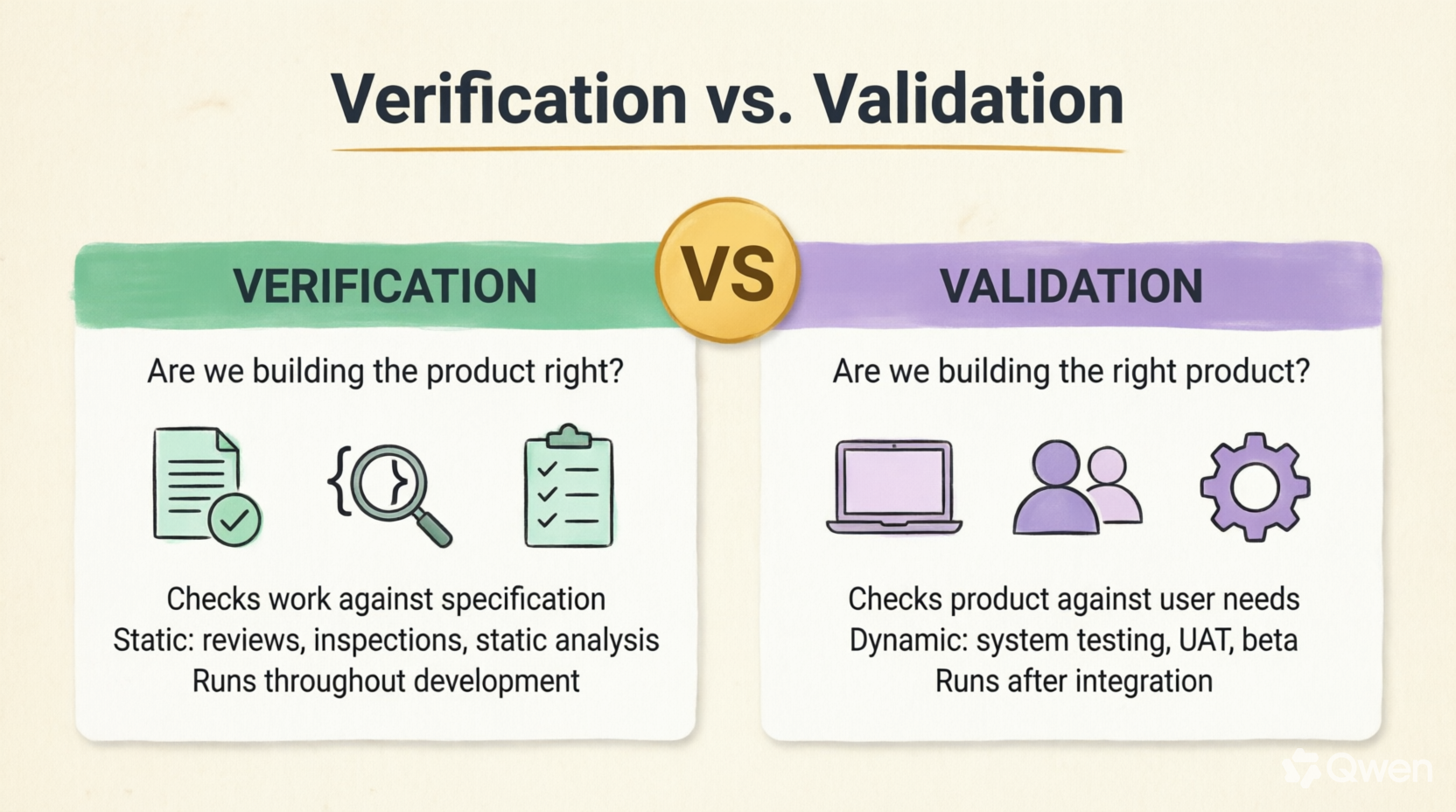
Verification vs Validation*
Definitions
The IEEE Standard Glossary of Software Engineering Terminology (IEEE-STD-610) defines verification as the process of evaluating a system or component to determine whether the products of a given development phase satisfy the conditions imposed at the start of that phase. In practical terms, verification examines whether the software is being constructed according to its documented requirements, design specifications, and coding standards. It is a check against an internal reference: the specification that the team agreed upon before writing the code.
Validation, by contrast, is defined as the process of evaluating a system or component during or at the end of the development process to determine whether it satisfies the specified requirements from the user's perspective. In practical terms, validation examines whether the finished software actually solves the problem it was built to solve, under conditions that resemble real use. It is a check against an external reference: the user's genuine operational needs, which may extend beyond what any written document fully captures.
Barry Boehm, in his 1984 paper "Verifying and Validating Software Requirements and Design Specifications," summarized them with two questions that remain the standard framing in the field. Verification asks, "Are we building the product right?" Validation asks, "Are we building the right product?" The first question concerns conformance to a plan. The second concerns fitness for purpose.
Verification in Practice
Verification is process-oriented. It examines the artifacts produced during development: requirements documents, architectural designs, module specifications, source code, and test plans. Its goal is to detect deviations from the specification as early as possible, before those deviations propagate into later stages where correction becomes significantly more expensive.
As Roger Pressman outlines in his foundational text on software engineering, verification activities are broadly categorized as static SQA techniques. Because they examine documents and code text without executing the program, they serve as early quality gates that prevent implementation errors from propagating into later development stages.
A defining characteristic of verification is that it does not always require executing the software. Many verification techniques are static, meaning they examine documents or code without running them.
Reviews and inspections are structured examinations of work products by a team of peers. A requirements review checks whether every stated requirement is testable, unambiguous, and consistent with the others. A code inspection checks whether the implementation conforms to the design document and follows the team's coding standards. These activities catch logical errors, missing cases, and contradictions before a single line of code is executed.
Static analysis uses automated tools to scan source code for violations of coding standards, unreachable branches, potential null pointer dereferences, and type mismatches. The code is never run. The tool reads the program text and applies a set of rules to it. This technique is particularly effective at catching patterns that human reviewers frequently miss during manual inspection.
Walkthroughs are less formal than inspections. The author of a document or code module presents it to a group of colleagues, who ask questions and flag potential issues. The goal is to surface logical gaps or assumptions that the author may not have noticed.
Unit testing against specifications verifies that individual functions or modules produce the outputs defined in their interface contracts. If a function is documented to accept a temperature reading in Celsius and return the equivalent in Fahrenheit, a unit test confirms that it does so correctly for a range of inputs, including edge cases such as absolute zero and the boiling point of water.
In every case, verification measures the work product against a written standard. The question is never whether the user will be satisfied. The question is whether the artifact matches what the team specified it should do.
Validation in Practice
Validation is product-oriented. It examines the working software to determine whether it meets the actual needs of the end user in the intended operating environment. Unlike verification, validation inherently requires executing the software. You cannot confirm that a product is useful without running it and observing its behavior under conditions that approximate real use.
Validation typically occurs in the later stages of development, after the system has been integrated and is functionally complete. However, it can also be performed incrementally through prototypes, iterative demos, and continuous user feedback loops.
System testing evaluates the complete, integrated system against the system requirements specification. It tests the software as a whole, including interactions between modules, external interfaces, databases, and hardware components. The goal is to confirm that the assembled system behaves correctly under realistic workloads.
User Acceptance Testing involves actual users or customer representatives operating the software in scenarios that reflect their real workflows. The testers are not checking whether the code matches a specification. They are checking whether the software allows them to accomplish their tasks correctly, efficiently, and without confusion. Their feedback often reveals requirements that were never written down but were always assumed.
Beta testing releases a pre-production version to a limited group of real users in their own environments. Feedback is collected on usability, performance, and correctness under conditions that the development team cannot fully replicate in a laboratory.
Operational testing runs the software in the target production environment with real data to confirm it performs as expected under actual load, network conditions, and user behavior patterns.
In every case, validation measures the product against the user's genuine needs. It acknowledges that a specification can be wrong, incomplete, or misinterpreted, and that the only definitive confirmation of usefulness is observing the product in the hands of the people who will rely on it.
A Concrete Example
Consider a team developing the control software for a six-floor elevator in a university building.
The specification states the following:
when a passenger presses a floor button, the elevator shall move to that floor within 30 seconds, stop with a maximum position error of 5 millimeters relative to the floor level, and open its doors within 2 seconds of arriving. The doors shall not open if the elevator is more than 5 millimeters away from the correct floor position. The system shall support a maximum load of 1000 kilograms and shall not move if the load exceeds this threshold.
Verification activities for this system would include the following.
Requirements review: The team reads the specification and confirms that every constraint, such as the 30-second travel time and the 5-millimeter stopping tolerance, is testable and unambiguous.
Code inspection: Engineers examine the motor control code against the design document and confirm it implements the specified acceleration and deceleration profile.
Static analysis: Automated tools scan the position calculation module without running it and report no division-by-zero errors, unreachable branches, or type mismatches.
Unit testing: The controller module receives a sequence of target floor requests and returns motor outputs that match the expected values within the specified tolerances.
Overload check: A simulated cabin load above 1000 kilograms triggers the warning signal and prevents the elevator from moving, exactly as the specification requires.
All verification checks pass. The code does exactly what the specification says it should do.
Validation activities for this system would involve the following.
Field trial: Students, faculty members, and facilities staff use the elevator as their normal transport for a two-week period in the actual building.
Peak-hour observation: Between classes, 40 to 50 students press call buttons at the same time across multiple floors, creating the traffic pattern the system will face every day.
Scheduling flaw: The algorithm serves floor requests in sequential order and ignores travel direction, so students waiting to go down watch the car pass their floor three times while it serves upward requests.
The verdict: Every specified behavior works correctly, yet the product fails the real operational need, which is moving large groups efficiently during class transitions.
The specification captured the mechanical constraints but did not account for the traffic pattern of a university building.
This example illustrates the central point. A product can pass all verification activities and still fail validation. The code is correct according to its specification, but the specification did not capture what the users actually needed.
Key Differences
The distinction between verification and validation can be understood along several dimensions.
In terms of orientation, verification is process-oriented. It examines whether the development process is being followed correctly and whether each intermediate artifact meets its stated criteria. Validation is product-oriented. It examines whether the final deliverable satisfies the user's needs.
In terms of timing, verification occurs throughout the development lifecycle. Every phase produces artifacts that can be verified against the inputs of that phase. Validation occurs primarily in the later stages, after a working product exists, though it can be performed incrementally through prototypes and iterative feedback.
In terms of execution, verification can be performed without running the software. Reviews, inspections, and static analysis examine documents and code text. Validation requires executing the software because it assesses runtime behavior against user expectations.
In terms of responsibility, verification is typically performed by the development and quality assurance teams who are intimately familiar with the specifications. Validation is performed by testers, end users, or customer representatives who assess the product from an external perspective.
In terms of what they detect, verification finds deviations from requirements and design. It catches implementation errors. Validation finds gaps between the product and the user's actual needs. It catches specification errors, missing requirements, and usability issues that no document anticipated.
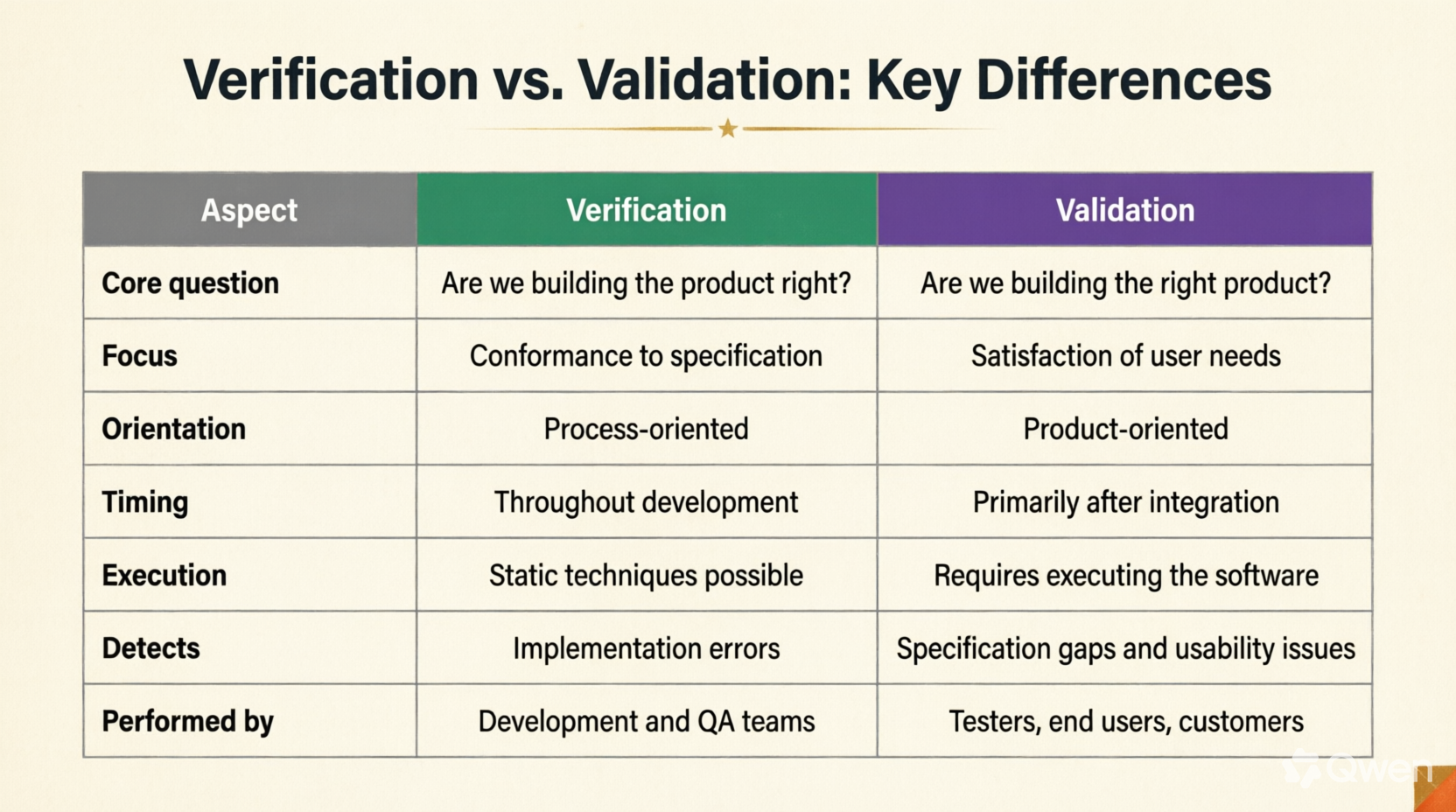
Key Differences Summarized*
Why Both Are Necessary
Treating verification as sufficient, without performing validation, produces software that is technically correct but practically inadequate. The code compiles, passes all unit tests, conforms to the design document, and yet fails to solve the user's problem because the requirements themselves were flawed or incomplete. The elevator example demonstrates this precisely: every mechanical constraint was met, but the traffic pattern was never specified.
Ian Sommerville maps this distinction directly to the V-Model of software development. Verification aligns with the left side of the model, ensuring that design and code conform to specifications. Validation aligns with the right side, ensuring the final product meets user needs. Sommerville also emphasizes the economic reality of this distinction: a verification defect caught during a code review costs very little to fix, whereas a validation defect discovered by an end user in production carries an exponentially higher cost.
Treating validation as sufficient, without performing verification, produces software that appears to work during demonstrations but contains architectural violations, untested edge cases, and latent defects that surface under load or in unexpected conditions. The product satisfies users during a controlled trial but fails catastrophically in production when it encounters inputs or workloads that were never tested internally.
Quality assurance requires both activities operating in concert. Verification ensures internal consistency and correctness. Validation ensures external relevance and usefulness. Neither is a substitute for the other, and a mature testing strategy integrates both throughout the development lifecycle.
References
IEEE Standard Glossary of Software Engineering Terminology, IEEE Std 610.12-1990.
Boehm, B. W., "Verifying and Validating Software Requirements and Design Specifications," IEEE Software, vol. 1, no. 1, pp. 75–88, January 1984.
Sommerville, I., Software Engineering, 10th ed., Pearson, 2016.
Pressman, R. S. and Maxim, B. R., Software Engineering: A Practitioner's Approach, 9th ed., McGraw-Hill, 2020.
*All the images were generated with Qwen3.8-Max
Subscribe to Transmissions
Join the archive to receive notifications when new projects, articles, or videos are catalogued. Transmissions are sent weekly or biweekly - never more.